
Every Dressmaker fabric sorted into the eight types the game checks: how many exist, what they cost, the tags they carry, and when burlap is the right buy.
Dressmaker Fabric List: All 359 Fabrics And The 8 Types
There are 359 fabrics in Dressmaker, and every one of them belongs to exactly one of eight types: Cotton, Lace, Linen, Sequin, Silk, Velvet and Wool, plus Burlap, which has a single fabric to its name. You start with 156 of them unlocked at Rank 0, and the rest arrive rank by rank. Silk is the deepest family at 116 fabrics; Lace is the shallowest at 10. The type is what commissions check when a card says "Use only silk" or "Lace: at least 40%", so the type column matters more than the colour you fall in love with.
- 359 fabrics, 8 types, one type per fabric, no exceptions
- 156 fabrics on the wall at Rank 0; the Emporium adds more with each rank
- Silk 116, Cotton 83, Velvet 55, Wool 39, Linen 28, Sequin 27, Lace 10, Burlap 1
- Burlap is the only free fabric, and it drags most style tags down
- A "Use only" line fails on a single cut piece of another type; a percent line counts area, not metres bought
The eight fabric types, and how many fabrics each holds
The counts below come from the community fabric index, which lists every bolt in the game; the short descriptions are the practical read on each family rather than an official tier list.
| Type | Fabrics | Cost feel | What it is for |
|---|---|---|---|
| Silk | 116 | Dearest | Eveningwear, Glamour, Elegant, Formal; the widest choice of prints and sheens |
| Cotton | 83 | Cheapest | Daywear, Casual, Cute, Simple; the workhorse for everyday commissions |
| Velvet | 55 | Dear | Romantic, Glamour, winter Formal; heavy drape, strong colour |
| Wool | 39 | Cheap to mid | Professional, Formal, Simple; tweed and pinstripe patterns live here |
| Linen | 28 | Cheap | Daywear, Simple, Cool; flat pricing, good for summer briefs |
| Sequin | 27 | Dearest | Glamour, Party, Eveningwear; carries Elaborate hard |
| Lace | 10 | Mid | Romantic, Elegant; the type most often named by a percent line |
| Burlap | 1 | Free | Nothing. It is the penalty fabric |
Every fabric is a single type even when the name suggests otherwise. A "Lace on Red Silk" bolt sold on the fabric wall is a Silk fabric with a lace print, not a Lace fabric, and it will not fill a "Lace: at least 40%" bar. If a commission names a type, read the label under the bolt name in the Emporium panel rather than the name itself.
What a fabric actually does to a score
Fabric is not a flavour choice. Each bolt carries tag points, and those points are added to the dress's tag bars by dress part. The game weights the parts: the skirt gives 40% of the fabric's tag points, the bodice 35%, the sleeves 15% and the collar 10%, and a missing collar or sleeve hands its share to the other parts. Inside a part, each cut piece counts by its size, and only pieces actually on the mannequin count.
That weighting is the single most useful thing to know when a bar will not fill. A silk with Eveningwear 100 on the skirt moves the bar roughly twice as far as the same silk cut as a sleeve. The quality and scoring guide walks through the rest of the tag maths, including how patterns and accessories stack on top.
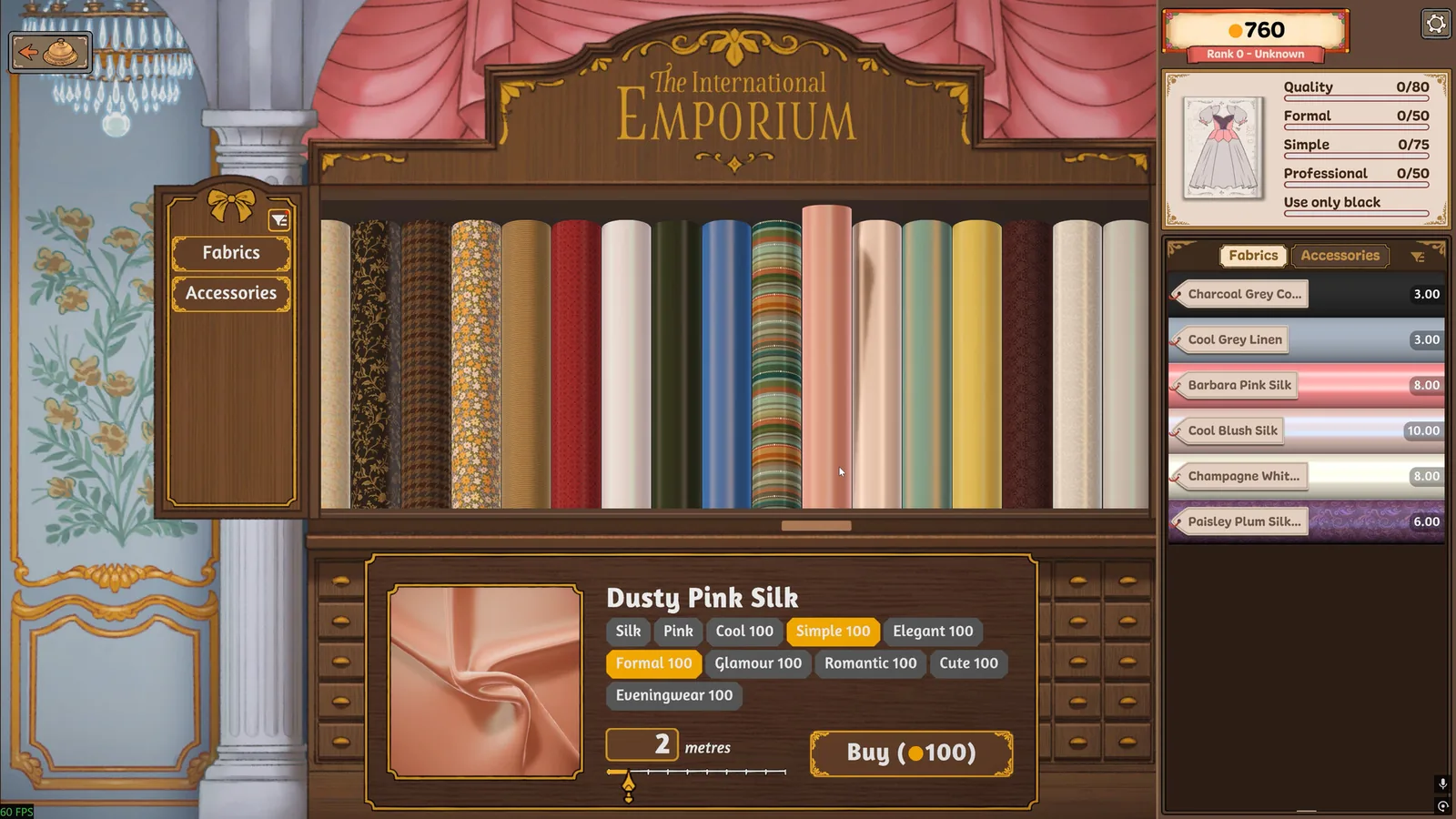
The Emporium panel shows the selected bolt's tags as chips with values of 25, 50 or 100. A 3 gold cotton with Daywear 100 beats a 10 gold silk with Daywear 25 for a daywear commission, and it leaves gold for trim.
Prices: what the shop actually charges
Fabric is priced by the metre and the spread is wide, not fixed per type. A sampled Emporium screen from launch showed Charcoal Grey Cotton at 3.00 and Cool Grey Linen at 3.00, Barbara Pink Silk at 8.00 and Cool Blush Silk at 10.00 per metre, while other screens show printed cottons well under 2.00. Community price tables that list whole-number tiers per type put silk, sequin and velvet at the top and cotton and wool at the bottom, which matches the shape of the shop even where the exact figures differ by build.
Treat the live shelf price as the only price. The game has been patched repeatedly since launch, including an October update that added new fabrics and accessories, so any static price list on the internet is a snapshot.
- There is no resale. Fabric bought by mistake is gone, and un-cut bolts only return to the shelf when you undo a cut.
- A bolt is a 10 metre roll, and the meterage you cut is tracked against the commission.
- Grain direction is scored separately; a badly aligned piece can lose points even with perfect tags.
"Use only" versus a percent line
These two requirement shapes look similar and behave nothing alike.
| Line on the card | What passes it | What fails it |
|---|---|---|
| "Use only silk" | Every cut piece on the dress is Silk | One cotton panel anywhere, including a collar |
| "Lace: at least 40%" | Cut fabric of that type covers 40% of the dress area, counted part by part | Buying extra metres; only metres on the mannequin count |
| "Silk: at least 60%" | Silk area across skirt, bodice, sleeves and collar | A silk collar alone, because the collar is only 10% of the line |
The percent line counts the dress, not your shopping. Because the skirt is weighted at 40% and the bodice at 35%, putting the named fabric on those two parts fills a percent bar fastest. A collar cut entirely in lace still only contributes its 10% share however small it is.
When cheap fabric is the correct answer
A Steam guide on tag scoring makes the point that for 18 of the 22 tags, the best points-per-gold fabric is already a 10 gold cotton or wool available at the start. Expensive fibre buys you a specific look or a specific type requirement, not a higher score by itself.
- Open the commission and read the requirement lines, not the mood text.
- If the line names a tag, sort the wall by that tag and buy the cheapest bolt with a high value.
- If the line names a type, filter to that type and take the cheapest colour that also carries a second tag the client wants.
- Only reach for silk or sequin when the card names the type, or when a Max line on Elaborate gives you room to spend.
Burlap, the free fabric with a cost
Burlap is the only fabric that costs nothing, and it is the only one that subtracts. Community data lists it at 0 gold per metre with penalties across most style tags, including a heavier hit to Eveningwear and Flowers. It is useful for exactly two things: testing a pattern layout with no money at risk, and building the cheapest possible off-the-rack dress to sell.
Even a free panel drags the whole tag bar down and can fail a Max-free card on its own. Use it in free design, not on a client's dress.
FAQ
How many fabrics are in Dressmaker?
359, split across eight types. The Emporium stocks 156 fabrics at Rank 0 and adds more at each rank, alongside 335 accessories in total.
Which fabric type has the most choice?
Silk, with 116 fabrics. Cotton is second at 83 and Velvet third at 55. Lace has only 10, and Burlap has one.
Is silk always better than cotton?
No. Silk is expensive and carries evening and glamour tags, but for a daywear or simple brief a cheap cotton with the same tag value scores identically and leaves gold for trim. Type only matters when the card names the type.
Why did "Use only linen" fail when everything I cut was linen?
One piece of another type is enough to fail the line, including a collar or a sleeve cut from a different bolt. Check every piece on the mannequin, not just the skirt and bodice. If a piece was cut in an earlier session it still counts.
Does buying extra metres help a percent line?
No. Percent lines count cut pieces by area across the dress parts, so extra metres in your inventory add nothing. Put the fabric on the skirt or bodice instead.
Is there a fabric price list that stays accurate?
No. Prices are per metre and vary by bolt and by build, and the October patch added new stock. Read the shelf price in the Emporium each time you shop.
Related Guides
- Dressmaker unlocks and the rank ladder explains which rank brings which fabrics to the Emporium.
- Dressmaker quality and scoring covers how fabric, patterns and trim stack into one tag score.
- Dressmaker trim and lace placement is the accessory-side companion to this page.
- Dressmaker patterns and cutting explains grain, layout and why a good bolt can still score badly.
Sources: Dressmaker on Steam, the community fabric type index for counts and requirement rules, the October Build 443 notes for the new fabrics, and a Steam guide on tag scoring.