
Who the Dressmaker cast is, how each client's style card and friendship stars work, and which requests to take first in a new save.
Dressmaker Game Characters: The Cast Behind the Cards
Quick answer: The Dressmaker cast is ten clients, each with a style profile, a budget and a short storyline. You meet them through commission cards rather than a party menu. Prudence is Victorian-coded and demanding; Rose is 1940s-coded and serves as the tutorial client.
- Ten clients, each with multiple commissions and a five-star track
- Requests are scored on Quality plus four style tags
- Prudence's Spring Fete card wants Quality 80, Eveningwear 40, Romantic 60 and three flower motifs
- A rejected commission still pays the budget and adds a quarter star
Who actually made these characters
Dressmaker is developed by Cozy Lives and published by Free Lives, the South African studio behind Broforce. The lead programmer is Jonathan Hau-Yoon, and the character designs come from Sabrina Becker, a real dressmaker who joined the project as a partner. The story is by novelist Kerstin Hall.
Becker's background shows in briefs that specify fabric behaviour, occasion and silhouette, and in clients who talk like people who have waited weeks for a fitting.
A dress can be beautiful and still miss a 60-point Flowers requirement. Match the bars first, then make it pretty.
The two anchors: Prudence and Rose
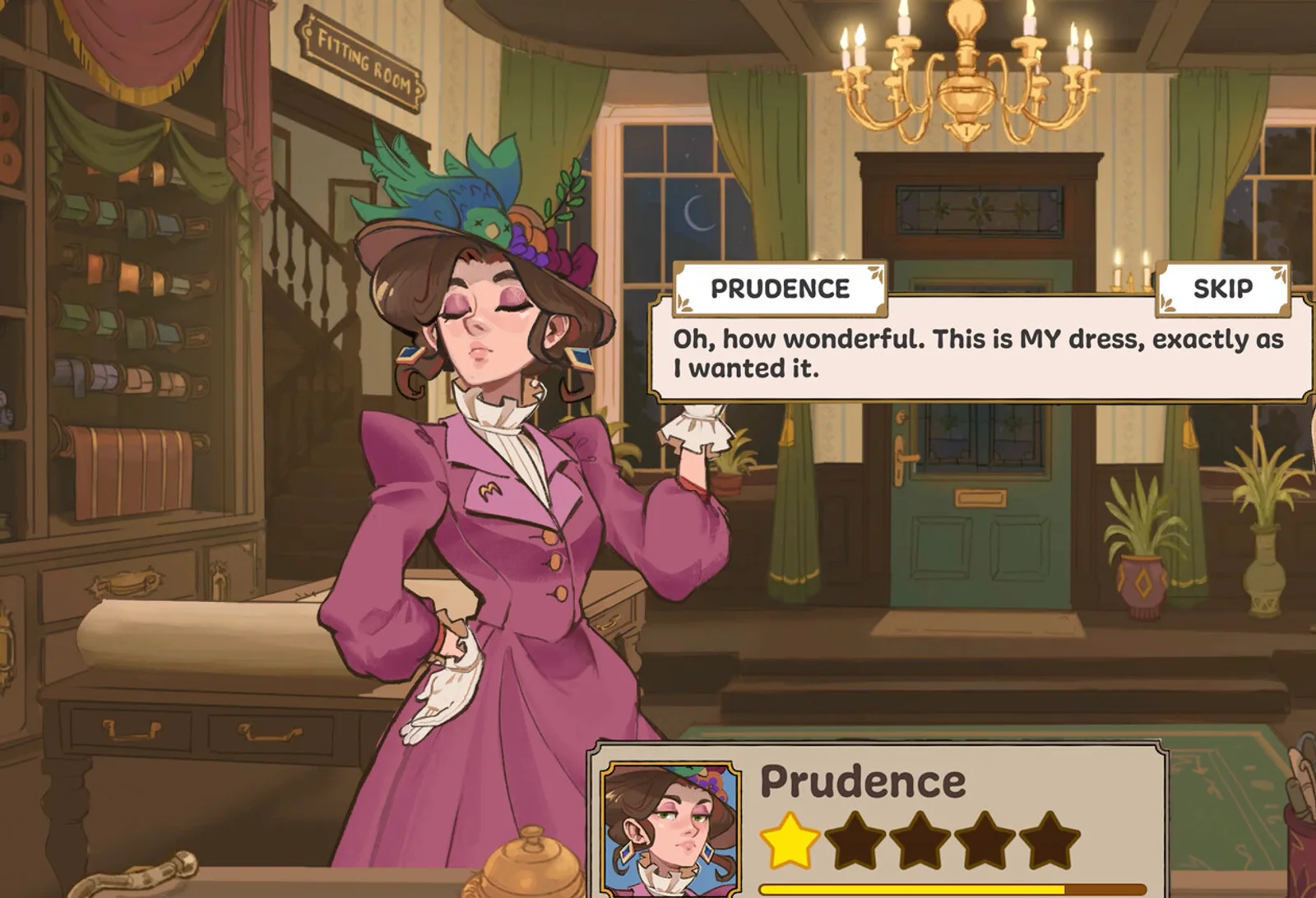
Prudence is the character most players meet first in marketing: a purple-suited Victorian with a feathered hat, a closed fan and a talent for backhanded compliments. Her requests lean eveningwear and expensive cloth. When pleased, she gets a full five-star portrait and a line that sells the fantasy: "Oh, how wonderful. This is MY dress, exactly as I wanted it."
Rose is the counterweight. The Guardian describes her as 1940s-coded, and her early commissions teach measuring, fabric choice and the sewing minigame without demanding silk. The contrast is deliberate: Becker designed the cast around different eras, then said Dressmaker "isn't era-specific, so as not to limit players", while still aiming for "a vintage feel".
How a character becomes a commission card
Each card combines four things: a story reason, a budget, a set of style targets and a material requirement. Prudence's Floral Romance is a clean example.
| Card element | Value | What it changes |
|---|---|---|
| Occasion | Spring Fete | Pushes the dress toward eveningwear and flowers |
| Budget | 750 gold | Gross pay on delivery, not an advance |
| Quality target | 80 | Sets the minimum sewing standard |
| Style targets | Eveningwear 40, Romantic 60, Flowers 60 | Scored separately from Quality |
| Material demand | Flower motif at least 3 | Forces trim and accessory choices |
The style bars are not suggestions: falling short on one can fail the commission even when the dress looks right. For the full client list and their arcs, see the characters guide. Hau-Yoon told the Guardian there are no branching paths that lock you out of dresses, so the cast is a completionist checklist, not a loyalty puzzle.
Friendship stars and what they reward
Every client has a five-star track. The portrait in the corner shows the current star and a progress bar toward the next one. A successful commission fills that bar; a rejected commission adds a quarter star, so a bad delivery slows the relationship rather than resetting it.
Stars are the reason to keep taking low-paying cards: the early money is thin, but the track gates later, richer commissions.
Giving a finished dress as a gift pays nothing. It is a relationship and prestige move, not income. If you need gold for fabric, sell the dress instead.
What stars unlock, and what rank does
The two progression tracks are easy to mix up, and mixing them up is why players feel stuck at Rank 12 with no new patterns.
| Track | Whose it is | What it unlocks |
|---|---|---|
| Friendship stars | One client | That client's patterns and later commissions, up to five stars |
| Shop rank | The shop | Fabrics and accessories in the Emporium, plus 1% on every sale |
Stars are per client, so five stars with Rose does nothing for Prudence's pattern list. Rank is per shop, so it opens stock that any client can then be dressed in. The game does not publish which pattern sits behind which star, so the practical read is the pattern list after each promotion. The rank guide has the full 51-rank ladder, and the fabric list shows what the stock side actually contains.
A gift that lands gives friendship only, and a gift that misses gives a quarter star plus a quarter prestige point. If you are chasing a pattern, gift. If you are chasing stock, deliver commissions and read the newspaper.
Which clients to prioritize
Take Rose's tutorial line first. It pays little, but it teaches the scoring bars before the budgets get big enough to hurt. After that, prioritize clients whose style targets match the fabric you already own, because leftover bolts are sunk cost and a matching request turns them into margin.
Save Prudence for when Quality can clear 80 without re-cutting: her budgets are large, but a failed evening gown still eats expensive cloth. Vivian's Dark Emissary pays 1,250, but only once your rank multiplier covers the velvet.
FAQ
How many characters are in Dressmaker?
Ten clients, each with a multi-commission storyline and a five-star friendship track.
Who are the main characters?
Prudence and Rose are the two the developers have discussed publicly. Prudence is the Victorian-coded eveningwear client; Rose is the 1940s-coded early client who teaches the basics.
Do choices lock me out of characters?
No. There is no branching that prevents you from making every dress, so the cast is not a loyalty puzzle.
Related Guides
- Dressmaker characters list: every client and their story arcs.
- Prudence guide: her requests and style targets.
- Dressmaker money guide: budgets, sale prices and the rank multiplier.
- Vivian guide: the 1,250-gold Dark Emissary commission.
- Dressmaker ranks: the 51-rank ladder, every prestige source and what rank actually opens.
Sources: Dressmaker on Steam, The Guardian's developer interview, and Wikipedia.