What you actually do in Dressmaker: measure draft cut sew sell, off-the-rack income, and the hidden sabotage route.
Dressmaker Gameplay: Loop Commissions and Sabotage
Dressmaker gameplay is a seven-stage tailoring loop: ring the bell to call a client, record their measurements, draft the pattern in the sketchbook, buy fabric, cut it on the grain, sew the seams, then deliver the commission or sell the dress off the rack. Coin pays for cloth, rank unlocks more of it, and a hidden sabotage route lets you ruin dresses on purpose for their own endings.
- One loop with no skips. The game blocks progress until each stage is finished.
- Two tills feed the wallet. Commission budgets pay on delivery, off-the-rack sales pay at the finish dialog.
- Sabotage is official. The store page names it outright, and dresses ruined on purpose unlock their own storylines.
The core loop, stage by stage
Every dress in Dressmaker passes through the same eight stations, and the order never varies. Learn it once and every commission after the first is a variation on it rather than a new lesson.
- Ring the bell. You summon the next customer yourself. Before Build 403 the queue arrived on its own, so controlling the bell is now part of the strategy: no ring, no next client.
- Take the measurements. The mannequin rescales to the client, and the same numbers drive the flat pattern pieces. A mis-set mannequin distorts every panel you cut later, and wrong numbers can cap quality near 80 with no fix until that client returns.
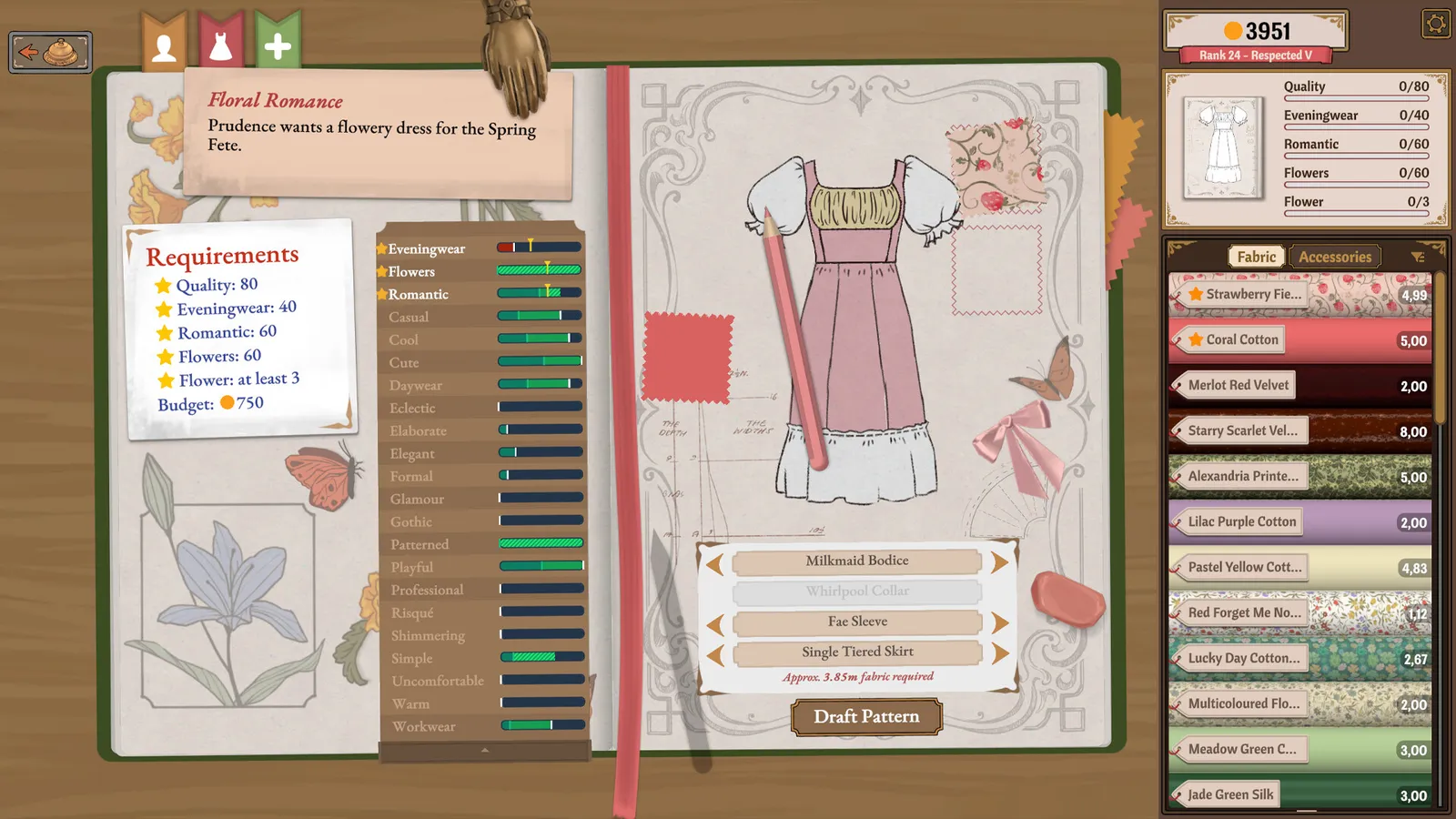
- Draft in the sketchbook. Bodice, collar, sleeve and skirt are picked with arrow buttons. The page prints an estimate in the form Approx. 4.73m fabric required before you spend anything, and you confirm with Draft Pattern.
- Buy fabric. The Fabrics panel lists cloths with a per-metre price. A first commission carries a budget around 800 while cloths list between 2.00 and 6.00, so cloth is priced well under the payout and running short means you bought badly, not that the game is stingy.
- Cut on the cutting table. Drag pieces from the Patterns panel onto the bolt, respect the printed ON GRAIN tag, and cut with the shears. Un-cut fabric returns to the bolt, so layout mistakes before the snip cost nothing.
- Sew. Feed each panel through the machine and hold the dotted seam line. Drift costs quality silently rather than failing the dress, and the Seam Rip button at the bottom right undoes a bad line.
- Dress the mannequin. Switch to the Accessories tab, place trims, buttons and appliques, and press Finish. Zoom sits on Z or a press of the mouse wheel, since rolling the wheel only spins the form.
- Close it out. The finish dialog offers Complete Commission, Continue Working, Sell dress, or Gift Dress. A dress built for a card ends with Complete Commission, while a free design ends with Sell dress showing the coin figure on the button.
Official source: Dressmaker on Steam lists the same chain in its own feature list: buy fabric, arrange and cut out patterns, preview them on a mannequin, sew them together, then turn in dresses for reputation and coin.
New players usually lose their first hour in two places: the grain tag on the cutting table and the seam line at the machine. Both are covered step by step in the tutorial walkthrough, which maps every sewing term to the screen it lives on.
Reading the commission card
The commission card is the brief, and everything on it is a number to satisfy rather than prose to admire. It carries the client dialogue, a coin budget, and a Requirements list of target attribute values, such as Quality 70, Flowers 60, Cute 30, Romantic 45 on one captured brief. The finishing panel then scores you as actual-over-target, where the same axes can read far above the targets.
Three card rules shape every decision you make:
- The budget is not an advance. It is what the client pays when they accept the dress, and it lands on delivery, not when you take the job. Accepting a 500 card while holding 200 changes nothing about your wallet.
- Delivery pays whether the dress passes or fails. Build 403 fixed the case where a failed commission paid nothing, with the note that if the character accepts the commission, you should be paid. A rejected dress still pays its budget plus a quarter friendship star.
- Some targets are ceilings, not floors. One player delivered a 100/60 quality dress and was sent back, because the request wanted at most 70. When a counter seems broken, check whether the brief caps the value before you re-sew anything.
Sort the queue by what each request physically demands. Style-score jobs in the warm, gothic, professional or playful registers cost design time only, since the sketchbook rates them live, so take those first. Fabric-tag jobs need a bolt you may not own, and trim-heavy briefs charge you twice, once for the cloth and once for the accessories. The characters guide gives the full triage order for a thin wallet.
Off the rack: the second till
Off-the-rack selling is the second income stream, and it opens after the third commission, with the option sometimes appearing right after the tutorial dress before the game explains it. The route needs no client at all:
- Open a free-design page with Make a New Dress in the sketchbook.
- Cut and sew it like any commission, with every seam stitched.
- Use Finish Dress on the mannequin and continue through the photo step.
- Read the price in the Dress Complete box and choose Sell dress.
The price appears on the button before you commit, which makes this the cleanest way to price-test a design without burning a client's patience. Several dresses can sit in progress at once, commission and free designs side by side, each with its own sketchbook page.
The sale price is materials at shop price plus 1 gold of labour per seam and per accessory, scaled by Quality and shop rank. Quality here is the no-client score, cutting and sewing only, so a client's wrong measurements do not touch it. A Quality 100 dress at rank 30 sells for about 1.95 times its cost, which is why a clean base decorated with one repeated brooch type is the fastest gold in the game. Full arithmetic lives in the money guide.
Coin and rank: the two tracks that never meet
Coin and rank are separate currencies and do not substitute for each other. Coin is the top-right balance and buys fabric, trims and accessories. Rank is the ribbon beneath it, your reputation track, and it gates new patterns, new fabrics and the story itself.
| Track | What feeds it | What it buys |
|---|---|---|
| Coin | Commission budgets on delivery, off-the-rack sales at the finish dialog | Fabric, trims, accessories |
| Rank | Deliveries, prestige from sales and gifts | Pattern unlocks, fabric unlocks, story progress |
There is no resale in the current build. Fabric or accessories bought by mistake are gone for good, and resale sits on the player request list rather than the published roadmap. The single recoverable material is un-cut fabric, which returns to the bolt when you undo a cut. That makes the fabric wall the real economy of the game: buy the bolt the current card needs, bank the difference, and let rank compound the 1 percent per-rank sale bonus across every dress after.
A silk no current commission needs is a permanent subtraction from every commission after it. If a client will not score well without the expensive fibre, take a cheaper client first and bank the difference. Skirt panels carry the most quality weight of any piece, so a bad skirt bolt hurts more than a bad sleeve bolt ever will.
The sabotage route: how ruining dresses works
Sabotage is not a cheat or an exploit. It is a named feature, printed on the store page as satisfy or sabotage, with its own storylines and endings. The same stations that build a good dress build a bad one, which means a saboteur needs real tailoring skill: a dress ruined clumsily gets sent back for a redo, while a dress ruined precisely gets accepted and triggers its cutscene.
The confirmed techniques, from players who mapped them, start small and escalate:
- Buy a cheaper fabric than the client wanted. Sometimes that is just business, and the dress still passes.
- Flip a pattern piece against the grain on purpose. Grain angle is the cheapest single-point sabotage in the game, and the client still accepts the dress if the rest of the request is met.
- Swap the trim for something close enough to pass as an honest mistake. Lace fabric will not tick a lace trim objective, so the reverse swap reads as a plausible error.
- Then escalate into set pieces. A prim librarian lined with stiff packing paper instead of soft cotton, a mourning veil swapped for rainbow pom-poms with squeaker pouches sewn into funeral attire, a farmer's sturdy work smock built from delicate silk organza that shreds in front of the whole town.
Official source: Polygon on Dressmaker sabotage documents the technique ladder and the set pieces above, and notes that one player had already pinpointed five distinct sabotages with comical results.
There are limits, and knowing them is what separates a working saboteur from a redo loop. One player tried handing a client a bright red dress against a camouflage request and the game kept sending it back. The wrong colour outright is rejected. The working pattern is subtler: give some clients exactly what they want on their first orders, build trust and rank, then hit a target with a bad order when they least expect it. The good dresses are the setup and the sabotage narrative is the payoff.
Sabotaging without wrecking your own shop
The fear that stops most players is reputation: does a ruined dress tank the atelier? The practical answer from the community is to treat sabotage as a second budget line rather than the end of the honest run.
First, sabotage on a foundation, not from zero. Early commissions fund the fabric wall and unlock the patterns and trims that make later sabotage expressive. A saboteur with rank 0 owns burlap and a grudge. A saboteur at mid ranks owns the organza, the pom-poms and the squeaker pouches.
Second, remember that delivery pays. A failed commission still pays its budget once the character accepts the dress, so a sabotage that lands inside acceptance still feeds the wallet that funds the next one. The dresses that pay nothing are the ones sent back for a redo, which is why subtle sabotage beats the red-dress blunder.
Third, keep the honest till running alongside. Off-the-rack sales do not care about any client's opinion, and a brooch dress funds whatever the sabotage run needs. The quality guide explains which failures are real mistakes and which are ceilings you can exploit, including the sub-70 commissions where deliberately bad sewing is the correct play.
Satisfy a target client once or twice before you strike. Players report that alternating good orders with a sudden bad one produces far better sabotage storylines than ruining the first dress you touch, and the endings guide covers which choices trigger each revenge cutscene.
The publisher describes the whole proposition in one line, and it is worth taking literally: a cozy crafting game inspired by real dressmaking where you satisfy or sabotage the townsfolk. The full feature list sits on the publisher Dressmaker page, and the store page confirms the developer is Cozy Lives under Free Lives with a 21 September 2026 release.
FAQ
What do you actually do minute to minute in Dressmaker? Measure the client, draft bodice, collar, sleeve and skirt in the sketchbook, buy fabric, arrange and cut the pieces respecting the grain tag, sew along the seam lines, place trims, then deliver the commission or sell the dress off the rack. One loop, eight stations, no skips.
How do commissions pay, and do failed ones pay anything? The card budget lands on delivery, not on acceptance, and a dress the character accepts pays its full budget whether it passes or fails, plus a quarter friendship star on a rejection. Only a dress sent back for a redo pays nothing, so finish the dress before you judge the payout.
When does off-the-rack selling unlock? After the third commission, with the option sometimes visible right after the tutorial dress. Open a free-design page with Make a New Dress, sew it fully, then read the price on the Sell dress button before committing.
How do I sabotage a client without getting the dress sent back? Ruin it precisely, not grossly. Cheap fabric swaps, flipped grain and near-miss trims pass, while a blatantly wrong colour gets rejected for a redo. Give the target one or two honest dresses first, then strike, since the acceptance check is what triggers the storyline.
Does sabotaging dresses hurt my shop rank? Sabotage is a supported route with its own endings rather than a fail state, and accepted sabotage deliveries still pay. Keep off-the-rack sales running as a reputation-independent income floor and you fund the whole revenge run without stalling unlocks.
Related Guides
- Dressmaker tutorial walkthrough - the eight stations in order, with every sewing term mapped to its screen.
- Dressmaker money and selling guide - budgets, the off-the-rack route, and the brooch dress that funds everything else.
- Dressmaker quality and scoring - requirement targets, ceiling commissions, and the route to a clean 100.
- Dressmaker characters and commissions - who asks for what, and which card to take when the wallet is thin.
- Dressmaker sabotage endings - which choices trigger each revenge cutscene once the sabotage lands.